Doug Drabik discusses fixed income market conditions and offers insight for bond investors.
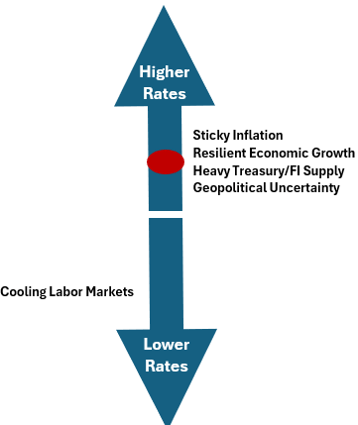
Predicting the direction of interest rates is challenging enough when economic conditions are relatively stable. Add persistent inflation, a resilient economy, a cooling labor market, geopolitical uncertainty, and an expanding supply of Treasury debt, and the challenge becomes considerably greater. These forces do not necessarily move interest rates in the same direction. In fact, several of today's most influential factors are pulling yields in opposite directions. The result is an ongoing tug of war, with the bond market continually reassessing which forces will prevail.
THE CASE FOR LOWER RATES
The labor market remains one of the more compelling arguments for lower interest rates. Slower hiring, fewer job openings, and signs of weakening employment demand suggest that economic momentum may be moderating. A cooling labor market gives the Federal Reserve greater flexibility to consider easing monetary policy, particularly if inflation continues to subside. Moreover, weaker employment conditions can dampen consumer spending, slow economic growth, and increase demand for the relative safety of Treasury securities. Each of these developments can contribute to downward pressure on yields. However, a weaker labor market alone does not guarantee lower interest rates, especially when other economic forces are pushing in the opposite direction.
THE CASE FOR HIGHER RATES
Several powerful influences continue to support elevated yields. First and foremost is persistent inflation. Although inflation has retreated from its previous peaks, the challenge of returning price increases sustainably toward the Fed's 2% target remains. Persistent inflation limits the Fed's flexibility to reduce short-term rates and can cause investors to demand additional compensation for holding longer-maturity bonds.
Meanwhile, the resilience of the U.S. economy presents another obstacle to lower rates. Stronger than expected economic growth, supported by consumer spending, business investment, and productivity gains, reduces the urgency for monetary easing. Although economic strength is generally welcome, it can also sustain inflationary pressures and keep longer-term Treasury yields elevated. A healthy economy does not necessarily translate into a favorable environment for falling interest rates.
Geopolitical uncertainty adds another layer of complexity because its impact on rates depends on which risks investors prioritize. Escalating global tensions can trigger a flight to safety, increasing demand for U.S. Treasuries and pushing yields lower. Conversely, disruptions to energy supplies, international trade, or global production can increase inflation expectations and push yields higher. The same geopolitical event can therefore create opposing pressures on interest rates, sometimes within a matter of days.
Finally, heavy Treasury issuance continues to put pressure on the bond market, particularly longer-term interest rates. Large federal deficits and substantial refinancing needs require the Treasury to continually attract investors to absorb new debt. When supply outpaces investor demand at prevailing yields, interest rates may need to rise to attract sufficient buyers. This pressure can be especially meaningful at the longer end of the yield curve, where investors must consider inflation, fiscal sustainability, and the additional risks associated with lending money over extended periods.
The accompanying illustration reflects the competing forces influencing today's interest rates. The direction of yields ultimately depends not simply on how many factors influence rate direction, but on the relative strength of each. The Federal Reserve controls short-term policy rates, while longer-term yields are determined by a broader combination of growth expectations, inflation, Treasury supply, and investor demand. These two parts of the yield curve do not always move together.
For investors, the takeaway is not necessarily to predict which force will be the most impactful. Rather, it is to recognize that today's interest rate environment offers an opportunity to secure meaningful income and cash flow without having to accurately forecast the next move in rates. Investors focused on principal preservation and predictable income may find greater value in aligning bond maturities and cash flows with their long-term financial objectives than in attempting to capture the exact peak in yields. Market conditions will change, but the contractual benefits of appropriately selected individual bonds can remain in place through maturity, subject to credit and call risks.
The author of this material is a Trader in the Fixed Income Department of Raymond James & Associates (RJA), and is not an Analyst. Any opinions expressed may differ from opinions expressed by other departments of RJA, including our Equity Research Department, and are subject to change without notice. The data and information contained herein was obtained from sources considered to be reliable, but RJA does not guarantee its accuracy and/or completeness. Neither the information nor any opinions expressed constitute a solicitation for the purchase or sale of any security referred to herein. This material may include analysis of sectors, securities and/or derivatives that RJA may have positions, long or short, held proprietarily. RJA or its affiliates may execute transactions which may not be consistent with the report’s conclusions. RJA may also have performed investment banking services for the issuers of such securities. Investors should discuss the risks inherent in bonds with their Raymond James Financial Advisor. Risks include, but are not limited to, changes in interest rates, liquidity, credit quality, volatility, and duration. Past performance is no assurance of future results.
Investment products are: not deposits, not FDIC/NCUA insured, not insured by any government agency, not bank guaranteed, subject to risk and may lose value.
To learn more about the risks and rewards of investing in fixed income, access the Financial Industry Regulatory Authority’s website at finra.org/investors/learn-to-invest/types-investments/bonds and the Municipal Securities Rulemaking Board’s (MSRB) Electronic Municipal Market Access System (EMMA) at emma.msrb.org.